MEXICO’S THIRD ROOT
A long-overdue shift came in 2020, when Mexico’s Population
and Housing Census formally recognized Afro-Mexican identity
by including a question that asked residents whether they identified as Afro-Mexican or Afro-descendant.

El amado de Afrodita - The Beloved of Aphrodite
El Ciruello, Oaxaca, Mexico, 1990

Padre Glynn - Father Glynn, Corrallero, Oaxaca, Mexico, 1989
Although Africans arrived in Mexico as early as the fifteenth century during the Spanish colonial period, Afro-Mexican histories and identities remained largely absent from mainstream media throughout much of the twentieth century, contributing to the marginalization and invisibility of these communities.
While Indigenous and mestizo identities occupied a central place in Mexico's national story, the histories and communities descended from enslaved Africans remained largely invisible.

La Pollera - The Chicken Seller, Cuajinicuilapa, Guerrero, Mexico, 1987

Tres Hermanas - Three Sisters, Cuajinicuilapa, Guerrero, Mexico, 1986
Photographer Tony Gleaton dedicated years
of his life to challenging that absence.
La boda de Maurillio y Teresa
The Marriage of Maurillio and Teresa
El Ciruello, Oaxaca, Mexico, 1990
Beginning in the 80s, Gleaton traveled extensively throughout Mexico's Costa Chica region, reaching parts of Oaxaca and Guerrero, where
many Afro-Mexican communities have lived for generations.

Nuestro cuarto de luz
Our Room of Light
El Ciruello, Mexico
1990
His photographs reveals an overlooked dimension of Mexican identity, one shaped by centuries of migration, resistance, cultural exchange, and survival.

Today, Gleaton's work stands as a historical preservation.
His photographs offer a powerful visual record of Afro-Mexican and Afro-Indigenous descendants, capturing everyday life at a time when these communities remained largely absent from mainstream media and scholarly discourse.
More than portraits, they are evidence of lives, cultures, and histories that have always been present, even when official narratives failed to acknowledge them.


Peluqueria - Barber Shop,
Pinotepa Nacional, Oaxaca, Mexico
1990
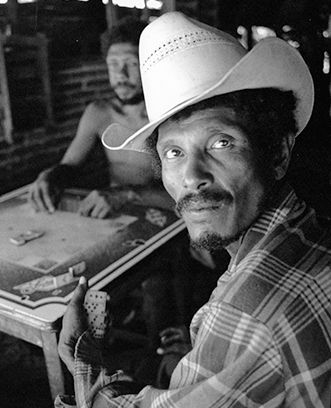
Dominos - Dominos
Corrallero, Oaxaca, Mexico
1990
Hombre y cayuco - Man and Canoe
Corrallero, Oaxaca, Mexico
1987
Madre joven con sus hijas
Young Mother with Daughters
Cuajinicuilapa, Guerrero, Mexico
1987